A four-layer pipeline from footage to intelligence.
Each layer consumes structured outputs from the previous one. The system is modular, independently deployable, and built to process a full 90-minute match from a single camera feed.
A person reads every submission. You get a reply within 48 hours — not an autoresponder.
Every layer consumes the one before it.
- 01Computer vision
See everything the camera sees
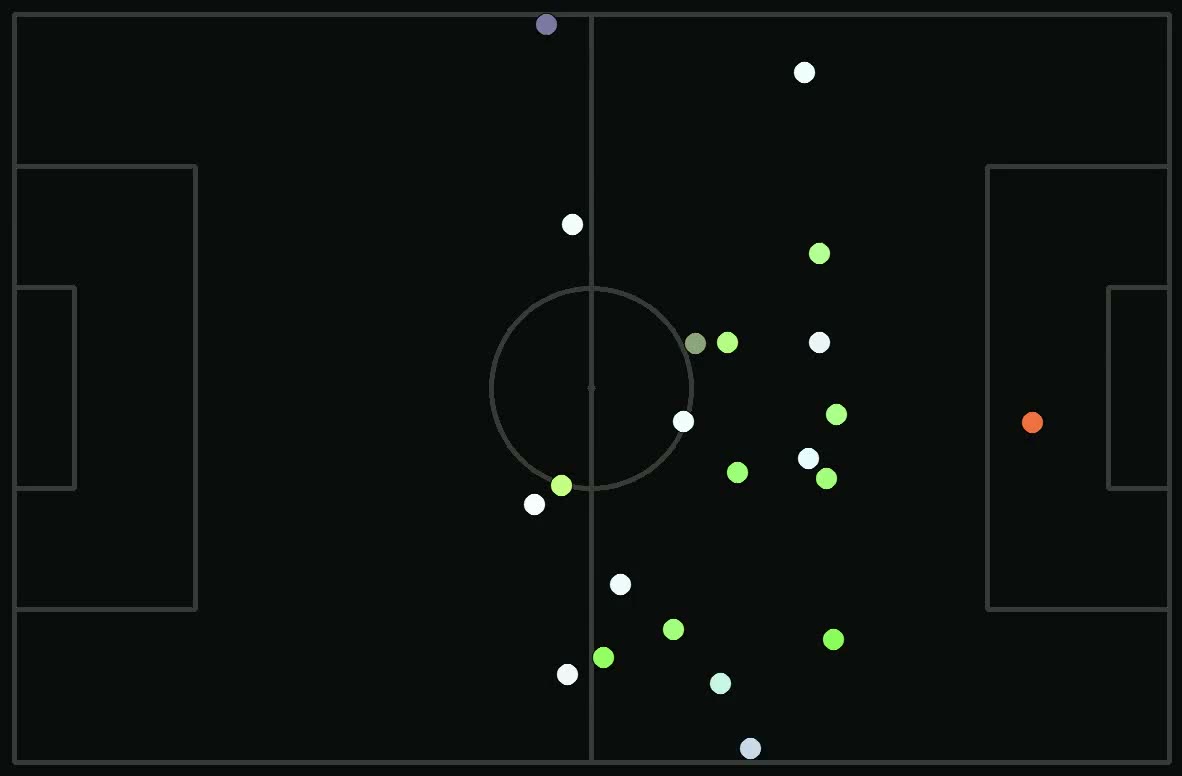
Single-camera footage is processed frame-by-frame — broadcast, tactical camera, drone or phone. Player detection, ball tracking, jersey segmentation, and pitch keypoint extraction all run simultaneously. Homography normalisation maps every player to a real-world 105×68 m coordinate system, from any angle that shows the play.
- Player and ball detection, frame by frame
- Positional accuracy in pitch metres
- Tracking ID stability
- 02Event engine
Every action, structured and labelled
Ball trajectory, player proximity, and velocity vectors combine to automatically detect passes, shots, crosses, dribbles, tackles and pressures. Each event is timestamped, attributed to a player, tagged with outcome, and stored with origin and destination coordinates.
- Pass completion + progressiveness
- Shot outcome classification
- Cross success rate
- Defensive action attribution
- 03Metrics engine
xG, xT, xA — from one camera angle
Every event feeds calibrated advanced metrics. Expected goals are computed from shot location, angle, defensive pressure and shot type. Expected threat quantifies the value of every ball progression across zone transitions. All metrics are league-adjusted and per-90 normalised.
- xG per shot · player · team
- xT contribution per action
- xA from key pass quality
- PPDA, pressing intensity, field tilt
- 04Intelligence layer
From data to decisions
Player embeddings, similarity search, undervalued flagging, league coefficient projections, and the tactical analyst all operate here. Clubs ask recruitment questions in plain language and get answers grounded in their own match data.
- Player similarity engine
- Undervalued prospect flagging
- League coefficient transfer model
- Analyst grounded in your metrics
Six stages, footage to metrics.
The four layers above are what the product does. These are the stages the engine actually runs, in order, named as they are named in the codebase. Each hands its output to the next, and each is measured independently.
- L0SubstrateFrame source, pitch registration, world projection
- L1PerceptionDetection, appearance, team and role assignment
- L2AssociationFrame-to-frame identity, optimal assignment
- L3ContinuityTracklets, gap linking, re-entry after occlusion
- L4AssemblyRoster binding across the match, substitutions
- L5OutputMetrics, reports, dashboard, export
Forty-plus metrics, per player, per match.
- Goals · Assists · xG · xA
- Shots · Shots on target
- Progressive carries
- xT contribution
- Final third entries
- Key passes
- Pass completion %
- Progressive passes
- Long ball frequency
- Forward pass %
- Pass network graph
- Build-up speed
- Tackles · Interceptions
- Pressure success %
- PPDA
- Defensive duels
- Clearances · Blocks
- Compactness score
- km covered / 90
- Sprint count
- Max speed
- Acceleration peaks
- High-intensity distance
- Deceleration load
Formation shifts, pressing triggers, set-piece patterns.
Sequence models operating on player coordinate time-series detect tactical structure per phase of play, updated throughout the match.
- Formation detection per phase — defensive, build-up, press, block
- Pressing trigger recognition — backward pass, sideline trap, isolated fullback
- Build-up shape analysis — width, depth, overload zones
- Set-piece pattern clustering — corners, free kicks, efficiency
Ready to see it on your footage?
Apply for early access and we'll process your first match free.